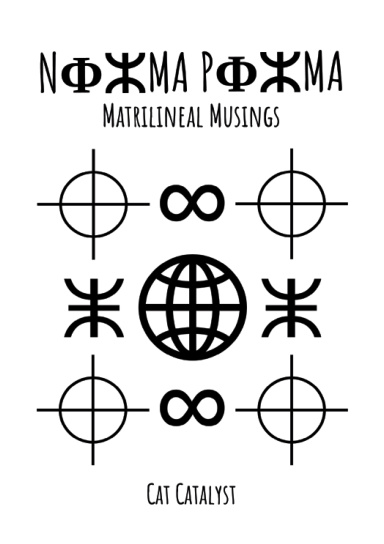
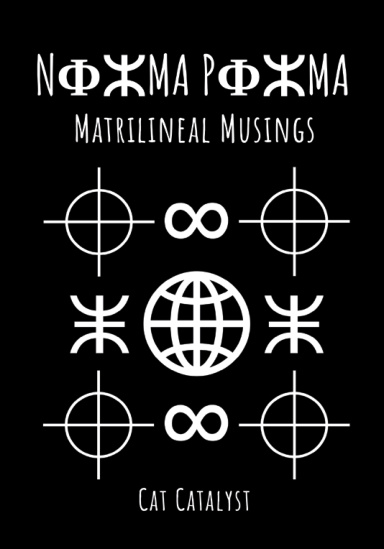
NΦⵣMA PΦⵣMA—(Nóēma Poēma)—operates as a multi-sensory project that merges print literature, digital audio, and wearable art. The project includes written verse and philosophical concepts alongside downloadable LP, EP, and single-release tracks. Additionally, 18 of these sonic pieces are integrated into a collected artist’s book, allowing readers to access digital layers via their smartphone to explore themes of decolonisation and sonic materiality.
NΦⵣMA PΦⵣMA has been a labour of love spanning a writing trajectory that began in the innocent 1980s, the last pre-digital decade of the 20th Century, embarking upon a journey of rapid change into a post-digital and post socially-distanced 21st Century, concluding with redefining three significant pillars of human experience:
1.The Recovery of True History: I bypass mainstream historical amnesia and patriarchal revisions to excavate a timeline recovery of former matrilineal tribes, societies and empires who respected and upheld the Toroidal Earth as a living system of divine intelligence that is self-generating and abundant.
2.Metaphysical Etymology and Acoustic Science: I use acoustic synthesis to shape language and music into a vehicle for psychospiritual evolution—In my sonic practice, poems are transformed into conscious house music encouraging listeners to physically embody gnosis through the ritual of dance.
3.Absolute Sovereignty over the Matrix Grid: Through a metaphysical synthesis of toroidal physics and pattern recognition, I reverse-engineer the self-generating torus as the matrilineal blueprint for a worldwide harmonic convergence between biology and consciousness—offering a functional solution for reclaiming spiritual sovereignty in a modern technological world.
The NΦⵣMA PΦⵣMA codex is not a stand-alone book. While it weaves poems, manifestos, transmissions, leading edge thought, autotheory, autoethnography and research together into one volume, it also links into visual book arts, sonic arts, interactive digital materiality, python code, song lyrics, music albums, video imaging, graphic design, streetwear, small publishing, and mythopoetic authorship, providing multiple pathways to embody gnosis through distinctively human acts of engagement, such as: reading, thinking, listening, looking, dancing and wearing.
It is designed to be read sequentially, chapter by chapter, at least once to gain a generational overview, where I actively encourage bookmarking pages, using a highlighter for verses, or paragraphs that resonate, looking up unfamiliar words, making notes in the margins, and going back to dip in, as some of the concepts are quite complex as the content is very concentrated, so it can take time to unpack. It is definitely a book that inspires spherical—’outside-of-the-box’—thinking.
iPoem’s Blog further serves as a companion site for each of the 138 titles that appear in the 457 page Noēma Poēma codex, providing a summarised review and a deeper dive into the mechanics of each poem, why the poem matters and its relevance in the collection.
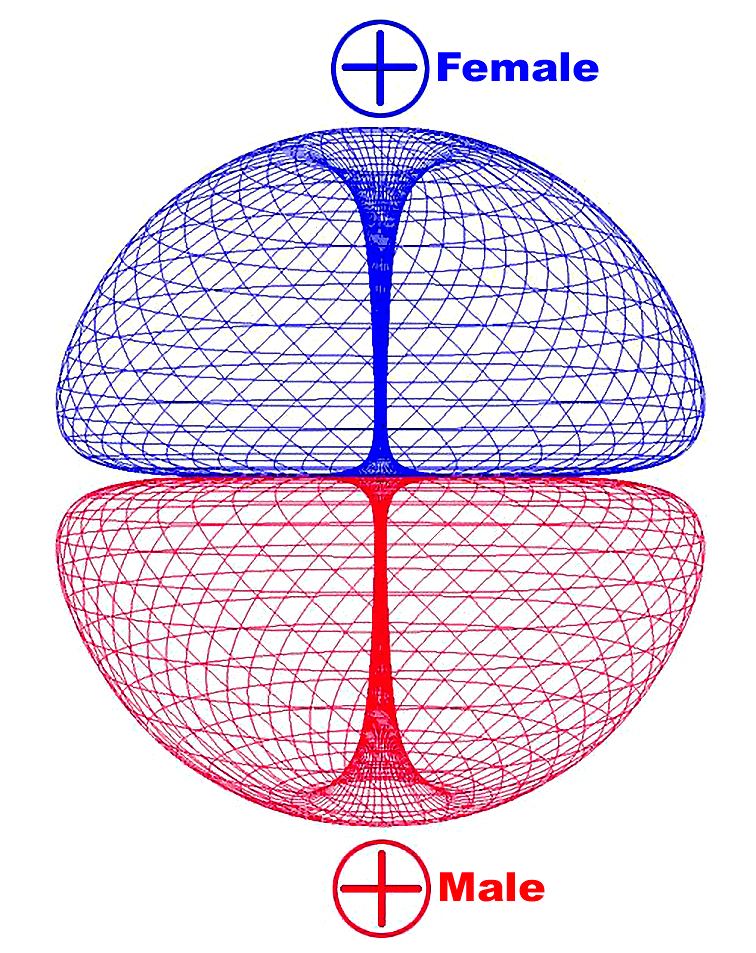
In my book I refer to the torus field as the Great Mother, as the torus is a fundamental geometric pattern of a self-sustaining energy flow, where energy moves through a central axis, radiates outward, and returns through the poles in a continuous, self-referential loop. This structure represents the unified field of quantised dielectric and electromagnetic energy, where the dielectric field (centripetal, inward-drawing) and the magnetic field (centrifugal, outward-expanding) are in dynamic balance, creating a stable, non-dissipative system. In this framework, the torus is not merely a static shape but a living system of spiritual intelligence, embodying the principle that matter and energy are manifestations of a coherent, organised flow. This pattern applies to all energy across all scales of existence—demonstrating the Hermetic axiom “As above, so below,” where the microcosm reflects the macrocosm.
The human heart generates the body’s strongest electromagnetic field, forming a personal toroidal field that can extend from several feet to several miles beyond the physical form, acting as the central broadcasting station for emotional and energetic coherence.
The toroidal field also serves as the bridge between the physical and spiritual dimensions, facilitating a self-generating cycle of creation and return. This continuous flow symbolises wholeness, unity, and the interconnectedness of all life, suggesting that consciousness itself is a property of this coherent, self-organising energy structure. And that by aligning with this natural pattern, individuals can achieve energetic balance, enhanced intuition, synchronicity, serendipity and a deeper connection to the universal toroidal field that underlies all creation, despite themes of external chaos.
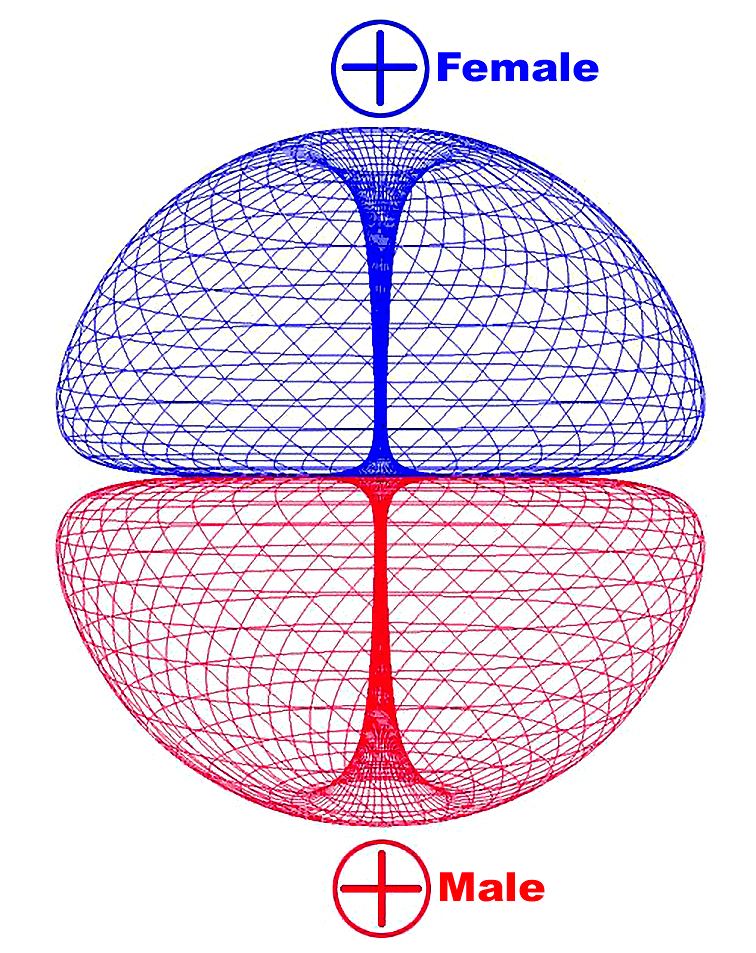
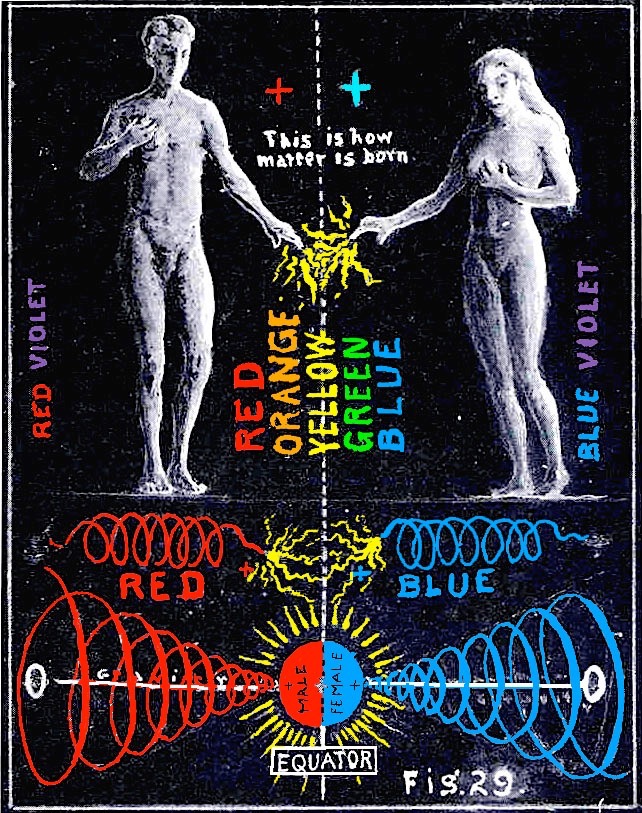
I symbolically frame the Centripetal Blueshift as representative of The Sophia (Gnosis) and the Centrifugal Redshift as the Christos (Embodied Gnosis), the proverbial marriage of heaven and earth, of the nonphysical spiritual with the physical material, which I describe as the Divine Twins of Creation. These twins represent the blueshift and the redshift of a dielectric magneto and electromagnetic torus field that sustains our universe. As in Walter Russell’s cosmology, there is no negative (-) pole as m and f are both positive (+) expressions of the same energy. One torus represents the ascent of consciousness, and the other represents the descent of gnosis into physical biology. Their intersection is the world itself. The triangles of the Star of David / Seal of Solomon represent the conical shapes formed by centrifugal and centripetal energy.
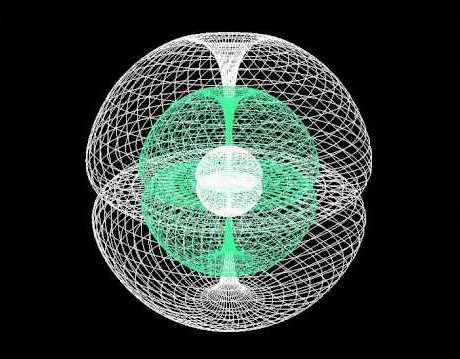
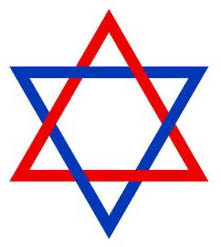
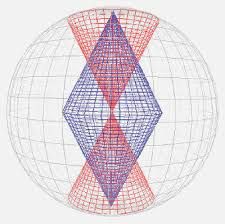

In Toroidal physics, the completion of the hardcopy book represents a cycle of nonphysical centripetal blueshift compression—the synthesis of complex concepts and ideas—into the centrifugal redshift expansion—the embodiment of physical method and form. This is the universal inhale that precipitates the exhale that all toroidal energy systems follow, from the microcosm to the macrocosm.
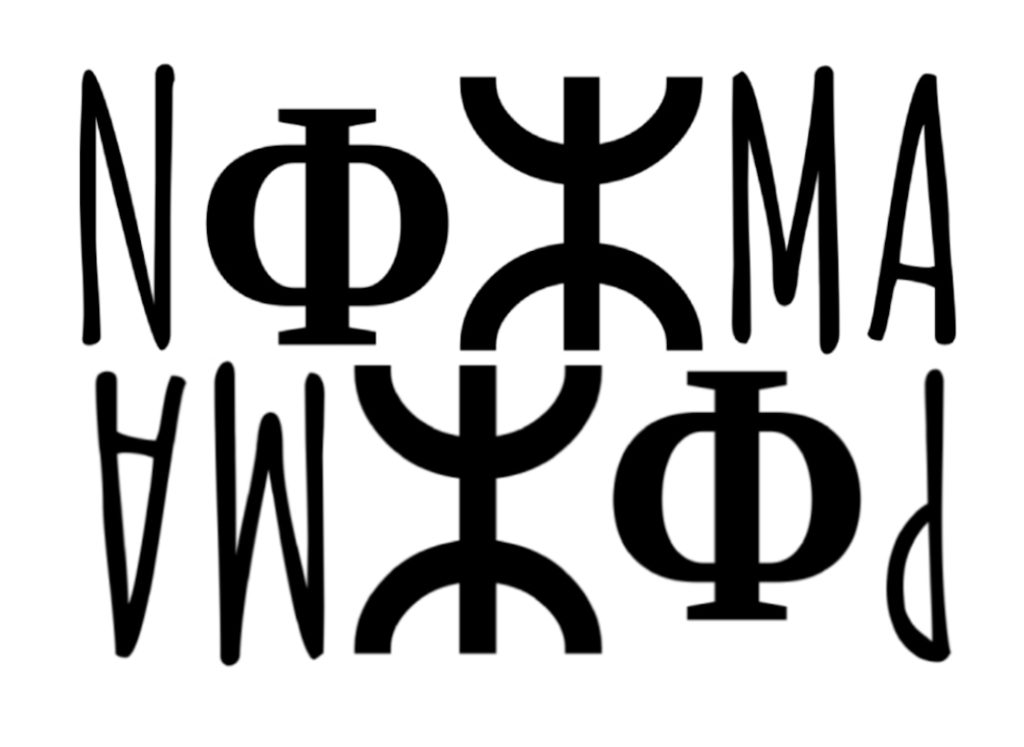
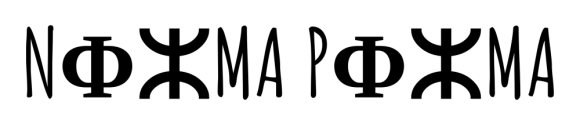
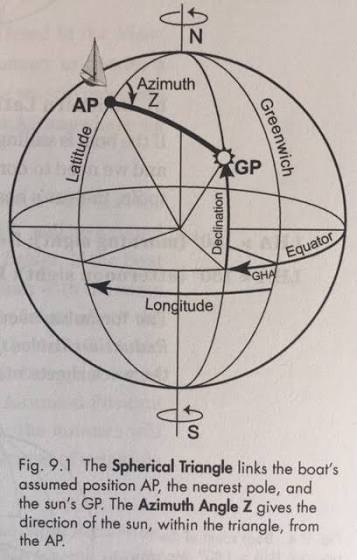
I chose the Phi (⏀), Yaz (ⵣ), Yazz (ⵥ) and the orientation (⌖) symbols for my front and back cover designs specifically to represent the torus field, with a vertical hyperbolic shaft through the middle, intersected by a horizontal inertial plane of equilibrium (equator). The orientation symbol (⌖) which is derived from the compass symbol, which in turn is derived from sailors using the fixed north star Polaris as a reference point, (and is no coincidence that a ship’s wheel looks like a compass), as this represents our being able to navigate the energy of the Earth’s toroidal field as it constantly spirals between states of compression and expansion.
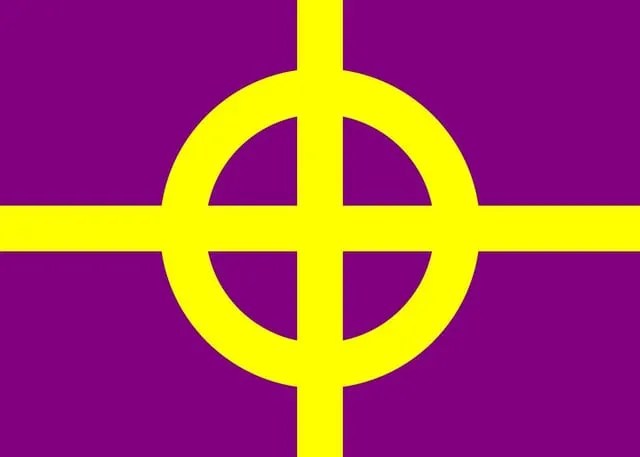
Shortly after drafting cover designs, I discovered that this symbol is also known as the ‘Cross of Neith‘—the emblem of the ancient Egyptian Goddess Neith, known as ‘The Great Mother’, the creator of the world and the primordial weaver of wisdom, from the ancient city of Sais (Zau, Sa el-Hagar) in the 5th Nome of Lower Egypt in the Delta, whose sanctuary bore the inscription: “I am all that has been, and is, and shall be, and my veil no mortal has yet uncovered.”
According to the Iunyt (Esna) cosmology, as Neith was the creator of the world, she was also the mother of the Sun (Ra), making Neith the mother of all of the gods. Therefore, Neith represents the self generating Parthenogenetic Torus Field. The circle with a cross represents the Inertial Plane intersecting the Hyperbolic Axis—the geometry of the toroidal earth, demonstrating that the ancients were well aware of the torus earth and the spiritual matriarchal significance, predating Christianity by at least three thousand years.
This same Cross of Neith is featured on the 13th-Century Welsh battle standard of Llywelyn ap Gruffudd, defending the matrilineal sovereignty of Wales against the encroaching patriarchal overthrow of the English Crown. The 1282 Welsh flag depicts a golden torus upon a purple background, representing true sovereign royalty which is an inner state of alignment with the outer toroidal field that is not something that can be won or inherited through bloodlines.
Reclaiming this symbol is a call to remember one’s inner sovereign allegiance to the Great Mother Torus as a living system of spiritual intelligence—the self-generating unified field of quantised dielectric and electromagnetic energy, where the dielectric field (centripetal, inward-drawing) and the magnetic field (centrifugal, outward-expanding) are in dynamic balance, creating a stable, non-dissipative system. To identify with this symbol is to restore the visibility of the Great Mother Torus and weave a new reality where true sovereignty is remembered through resonance.
Neith was one of the oldest and most powerful goddesses in ancient Egyptian mythology, worshipped from the Predynastic period through the Roman era. Her name reflects her immense authority as a primordial creator deity who emerged from the chaotic waters of Nun to weave the universe into existence. She was a multifaceted deity associated with war, hunting, weaving, wisdom, and childbirth. As a warrior, she was known as the “Mistress of the Bow” and “Ruler of Arrows,” (Sagittarius) often depicted wearing a Deshret, the Red Crown of Lower Egypt, holding a bow and shield. As Neith was a creator and mother goddess, she was revered as the “Great Mother” and the mother of Ra (the sun god), Sobek (the crocodile god), and sometimes Apep (the chaos serpent). She represents:
1) Wisdom and Justice: Neith was consulted by other gods to settle disputes, such as ruling in favor of Horus over Set in the Contendings of Horus and Set.
2) Signature Symbol: Her primary emblems were crossed arrows over a shield (archery) and possibly a weaving shuttle (creation/domestic arts) which I postulate is shaped more like a Vesica Piscis, the hyperbolic shaft viewed from the side, the throat of the torus where the inward and outward currents meet in perfect stillness.
3) Home: Her main sanctuary was in Sais in the Nile Delta, where she was identified by the Greeks with Athena.
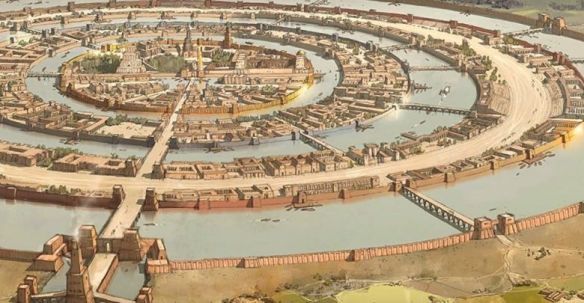
“The ancient city dates back to 3,000 B.C, however habitation at the site extends back to the pre-dynastic and Neolithic period, from at least 4,200 B.C. It was the provincial capital of the fifth nome of Lower Egypt, known as Sap-Meh. During the twenty-fourth dynasty of Egypt, spanning from 732–720 BC, Sais was the seat of power. At that time, it was known as Zau. This ancient city is well-known for many reasons. According to ancient texts, during the Pharaonic Era (around 3,000 B.C.) Sais was “cult center of the creator-and war-goddess – Neith.” Later, it was Egypt’s pharaonic capital. During the eponymous Saite Period (664-525 BC), Sais was a ceremonial center for kings. Greek historian, Herodotus, described Sais as a “great city,” declaring that it was the location of the grave of Osiris, the Egyptian god of the afterlife. Ancient Greek historians and scholars, including Herodotus, Plato and Diodorus Siculus, all identified Neith with Athena and even suggested a primordial link to Athens. Diodorus wrote that goddess Athena built Sais before the deluge that supposedly destroyed Athens and Atlantis. While all Greek cities were destroyed during that cataclysm, the Egyptian cities including Sais survived.” – M R Reese.
4) Funerary Goddess: Alongside Isis, Nephthys, and Serket, she protected the deceased’s transition into the afterlife.
Interestingly, the word manuscript contains the word ‘manu‘, from the Latin ‘manus’ which means hand, and scriptus, meaning ‘to write’ which historically translates to ‘written by hand’. In addition to ‘hand‘, the pages also have a ‘header’, a ‘footer’, a ‘body’ (of text), the book has a ‘spine’, and in older days a book was often covered with vellum, animal ‘skin‘. Taken together, these elements mirror the human form from head to toe—arranged around a central axis, these parts form both a physical torso and a living torus—a self-sustaining field where meaning and energy circulate continuously from spine to page and back again.
NΦⵣMA PΦⵣMA is also the completion of a lifelong soul contract. Ever since I was a young girl, I knew that I was going to write a book, but I did not know how I was going to do it, and I had no idea of just how broad the scope of the project would be when I started it. There were many times along the 38-year trajectory of writing and compiling when I thought that this ‘calling’ would never be fully realised. I could not see how it could happen, especially as someone who is Clairsentient, I feel information as resonance first, which I decode into language later. This is no easy task, as I do not think in words, as an artist I am a visual thinker, plus, I find that language tends to flatten out, or standardise a meaning and so it requires some unpicking. I do this by breaking a concept down into much smaller digestible chunks, often painting a visual collage with words so that it can be understood by everyone. This invariably involves a process of sitting with complex concepts, figuring out how multiple factors fit together and looking at the underlying symbolism behind the etymology beforehand, sometimes for years.
I chose not to go with an electronic PDF format this time, as I much prefer to hold a traditional analogue artefact in my hands, as I believe that there is still something rather magical and special about handling an actual book; the feel, the weight, the smooth tactile touch, the smell of freshly cut paper, printed ink, and the sound of the page as it turns, which through the act of physical engagement enables the memory to better retain information. As the printed page is gradually replaced by LCD / OLED screens, these acts of engagement awaken one’s inner tacit wisdom which are to be valued and cherished in a digital age. Iconic tech giants’ use of the word ‘kindle’ hints at the humble page disappearing ‘up in smoke’, or even at some kind of planned obsolescence of books, or trees, or both. (Why aren’t we using hemp for paper instead of trees anyway?)
______________________________________________________
—Cat is a collected book artist and post-graduate researcher-author, who combines post-digital poetics, avant-garde electronic music, and emerging technology with holistic spirituality. At the heart of these multimodal fusions lies the ‘Nóēma Poēma’ codex, serving as an invitation to bridge Heart, Mind and Source. More info: catcatalyst.co.uk
This fully revised and expanded 2nd Edition, consisting of 138 titles across 457 pages, has now reached its final iteration, replacing all earlier versions.
The hardback collector’s edition and general release softcover are available from my author’s online bookshop—the hardcover will remain as a collector’s edition available only from my website, while the softcover will shortly be available from most major online platforms. ⏀
______________________________________________________
NΦⵣMA PΦⵣMA (pronounced Nóēma Poēma) is a genre-defying body of poetics that transcends traditional literary boundaries, weaving manifesto, verse, transmission, philosophy, and invocation into a multidimensional map of the soul, spanning nearly four decades of radical research and creativity.
NΦⵣMA PΦⵣMA pulses with fierce devotion to truth, liberation, and love, grounded in ancestral matrilineal wisdom. This is poetry as praxis. Art as resistance. Philosophy as heartbeat—a spiritual document for those who feel the world cracking open, knowing that now is the time to reclaim sovereignty, embody gnosis, and return to Source.
NΦⵣMA PΦⵣMA is a rich, evolving mythopoetic narrative that blends avant-garde noetics and didactic instruction with storytelling and semi-fictional autotheory—a journey from the personal and intimate into the cosmic and transcendent. Read it slowly. Read it aloud. Let it rewire something ancient within you.


You must be logged in to post a comment.