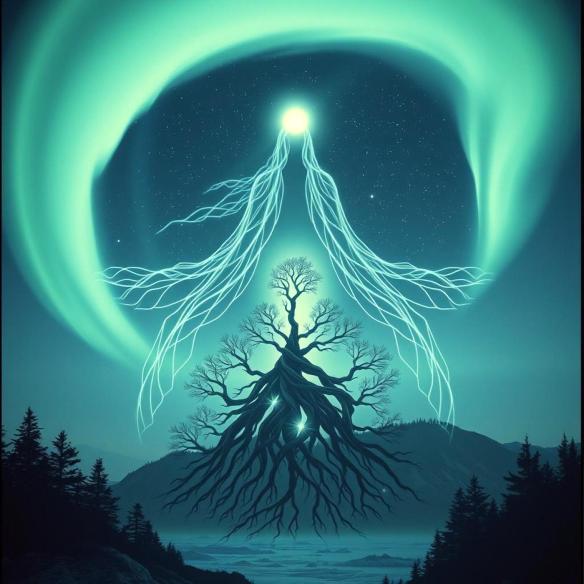
Click image to play video.
To PURCHASE track go >>HERE<<

The dawn of Dharma, sunrise of one’s best self
Ignites the joy of the mercurial mind, helmsman of the ship of life
Skillfully navigating 360 degree horizons
Long winding roads, deserts, shorelines and oceans
Climbing Babylonian towers, Jacob’s ladders and stairways to heaven
In search of the Chaldean order of ascension
Through the Æthers of enlightenment
Liberated from worldly entanglements
An ecstatic emersion from the bondage of outer validation
Like stars being released from the womb of the Æarth
Shining sparks of eternity in the glittering firmament of divine perfection
An enduring permanence, stagecraft of life, backdrop for scenes of temporal fluctuations
The cyclic coming to be and passing away of material karma
Seeded in the garden of elemental being
Beneath the revolving canopy of the heavens
The Thema Mundi of the Zoidion
Where choice and destiny are two sides of the same coin
The fine line between free will and determinism
In the twilight realm of hidden gifts disguised as challenges
Where difference is collapsed into unity
In the never ending pursuit of self mastery. ✩
___
i-PL©2023
Praxis marks a moment of poised philosophical culmination in the collection — a crystallisation of wisdom where the soul’s journey through illusion, awakening, and embodiment finds clarity through action aligned with truth. In Greek, praxis is the process by which theory or knowledge is enacted — and in this poem, it is spiritual wisdom made real, made visible, and made purposeful.
The piece fuses astrological, esoteric, and mytho-symbolic references into a sweeping yet focused meditation on Dharma — one’s sacred path or soul-calling — delivered in the language of the stars and the movement of the heavens.
The tone of Praxis is elevated yet grounded — poetic but precise. There’s a clear reverence for the sacredness of the journey, but also a mature understanding of the trials involved in living one’s truth.
The imagery is ethereal but not escapist: “stars being released from the womb of the Æarth” grounds the celestial in the feminine Earthly principle. The poem balances upward striving with downward rooting — true praxis requires both.
Words like “Thema Mundi” (the mythical birth chart of the world) and “Zoidion” (Greek for zodiac sign) offer a mythopoetic astrology, framing the individual as not just actor but microcosm of the macrocosm.
This is a milestone poem — a compact metaphysical blueprint for what it means to walk the path of enlightenment not in theory, but in embodied, day-to-day living.
Where previous poems explore soul origin, trauma, awakening, and remembrance — Praxis shifts the focus to application: how does one live as a starseed, an initiate, a sovereign being?
It’s the sacred bridge between divine knowledge and human responsibility — poetic gnosis translated into soul-guided action.
Placed at this point in the arc, Praxis serves as a pivot between the knowing and the doing. It doesn’t just summarise the teachings offered across the earlier works — it activates them.
It invites the reader (and the speaker) to become not just a student of Source-Energy but a co-creative participant in the unfolding divine play.
This poem could almost be a whisper from the higher self: a reminder that everything up to now has not just been for understanding — but for integration.
In the end, Praxis is a meditation on maturity — spiritual, emotional, and karmic.
“Where choice and destiny are two sides of the same coin / The fine line between free will and determinism…”
Here lies the realisation that awakening is not an escape, but a deeper participation in the great cosmic rhythm — lived deliberately, from the inside out.
It is a call to embody the sacred, to move beyond passive knowing and into inspired doing — with the soul at the helm and the stars as guideposts. ✩


i-PL©2023
The Second Coming is a rousing spiritual manifesto — not of apocalypse or judgment, but of awakening. It reclaims the prophetic tone of traditional religious language and reorients it toward conscious evolution and collective transformation. Rather than heralding a single saviour, this poem asserts that true salvation will come not through one figure, but through the mass unfolding of human potential.
The piece draws from spiritual, philosophical, and even metaphysical paradigms, yet remains grounded in the lived human experience — in our daily choices, responses, and interpersonal relationships.
In a time where global crises push us toward fear or disconnection, The Second Coming offers a hopeful alternative: that change is not only possible, but inevitable — and we each have a role to play.
The poet begins with a clear challenge to religious literalism:
“The second coming is not any one man / Or one woman / It is the explosion of collective consciousness”
This reframing is central to the poem’s power. It shifts the gaze from outer saviours to inner awakening, and from passivity to agency.
Key phrases like:
“When the ability to respond (response-able) / Is greater than to react”
“What one does to another / Actually, one does unto one’s own self”
…emphasise the transition from ego-driven separateness to a more compassionate, integrated way of being — an emotional intelligence that transcends reaction and cultivates accountability, empathy, and maturity.
The poem’s rhythm gathers momentum through the second half, building like a crescendo — a rising tide of possibility:
“Because the pain of staying the same / Will be greater than that of change”
“For it is humanity’s collective destiny / To evolve as a species / Beyond the comfort zone”
Here, we see a clear call to inner and outer revolution, grounded in healing — not dogma. The language blends metaphysical terms like “Primordial Qi” and “Source Energy” with spiritual archetypes: “inner god-goddess self,” “inner guru”, and “legendary inspirational role models” — grounding abstract ideas in relatable, accessible language.
The poet also names emotional evolution as core to the journey:
“How to love and accept the unloveable / Within the self / And each other”
“How to extend forgiveness, everyday!”
This is not utopian idealism, but practical spirituality — a daily discipline that trains the heart and mind to “align as one.” The reference to binary code — “From an Off to an On / Like a chain of dominoes” — cleverly modernises the spiritual awakening as a systemic, viral upgrade to collective consciousness.
The Second Coming is a poem of clarity, courage, and commitment. It reimagines salvation not as something we wait for, but something we participate in — actively, consciously, collectively. In this vision, everyone matters. No one is left behind.
With its grounded wisdom and visionary sweep, this poem encapsulates the underlying message of the collection: that personal healing and global transformation are not separate paths, but part of the same spiral of becoming.
This is poetry not just as art, but as invitation — to rise, awaken, and evolve.

This poem is a contemplative and spiritually grounded reflection on the interconnection between the inner self and the external environment. Rooted in a holistic worldview, it offers a gentle yet profound meditation on the state of the Earth as a mirror of human consciousness.
The poet presents the concept of Gaia not simply as a mythological figure, but as a living spirit residing within all individuals. This framing elevates the poem beyond environmental commentary, positioning it within a broader philosophical and spiritual context. The central assertion—that “what is within is reflected without”—forms the thematic spine of the piece and is handled with clarity and sincerity.
The structure of the poem is spare and deliberate. The free verse form, coupled with short, measured lines, gives the work a meditative rhythm. Each line appears carefully placed to allow the reader space for reflection. This stylistic restraint enhances the contemplative tone and aligns with the poem’s themes of inner peace and environmental harmony.
Linguistically, the poem is marked by clarity and economy. The diction is simple yet resonant, avoiding ornamentation in favour of direct expression. Phrases such as “self-love, -empowerment and -worth” display an innovative use of form that visually and rhythmically connects the ideas, suggesting their interdependence. The repetition of “self-” creates a quiet insistence on personal responsibility and healing as essential steps toward environmental stewardship.
The poem’s closing lines underscore the idea that true ecological change begins within. There is a sense of calm resolve, and the final star symbol (“✩”) serves as a subtle visual coda—lightly echoing the cosmic or spiritual dimension underpinning the work.
Overall, Environmental Awareness is a poised and sincere offering that succeeds in fusing ecological awareness with inner transformation. Its strength lies in its clarity, its contemplative tone, and its unwavering belief in the power of self-healing as a pathway to planetary renewal. The poet demonstrates both restraint and depth, producing a piece that is both timeless and quietly impactful.
 iPoem's Blog