
If Love Is introduced the universal field through which all things are connected, then Awakened explores the individual’s power to intentionally participate in that field as a conscious co-creator. The song serves as a poetic guide to attuning our energetic signature; our resonant vibrational offering, to a higher frequency rooted in love, truth, and focus.
The phrase ‘sinusoidal frequency’ refers to our electrical synapses that form neurological pathways in the brain and the number of complete cycles that occur within a specific time interval, which are measured in Hertz (Hz). These cycles are energetic feedback loops created by our most frequent thoughts, beliefs and emotions on constant rotation, which are summoning a now reality into being at any given moment, whether we are aware of what we are manifesting, or not.
Therefore, the challenge here is to become a ‘conscious creator’, summoning a now reality that is truly desired (rather than undesired), where one’s sponsoring thoughts for thinking, feeling, speaking or doing anything are always grounded in the Presence of Love, particularly in the light that all energy is eternal, as energy cannot be destroyed, or expire, it can only change form.
This means that when an internal frequency is intentionally shaped, its signature vibration is raised and refined, whereupon the Law of Attraction responds by shaping one’s outer reality accordingly to reflect what is happening on an emotional level.
Review / Summary / Overview for 105. Awaken
Overview
Awaken is a powerful spiritual manifesto calling for the re-empowerment of humanity through self-realisation and reconnection with Source Energy. It invites the reader to transcend fear, illusion, and manipulation by rediscovering the divine spark within—the “inner Mother-Father-God-Source-Energy Self.” The poem draws on esoteric, metaphysical, and political threads to expose the systems that suppress this awareness while simultaneously illuminating the path to higher consciousness and freedom. It’s both a revelation and a rallying cry—a poetic activation designed to awaken the sleeper within.
Why This Poem Matters
This poem matters because it articulates one of the central messages of the entire collection: the awakening of collective human consciousness. It speaks directly to the reader’s innate divinity and potential, offering liberation from fear, manipulation, and external control. In a time of global uncertainty and misinformation, Awaken stands as a luminous guidepost toward sovereignty, unity, and spiritual remembrance. It doesn’t merely describe awakening—it enacts it through language, rhythm, and revelation.
Imagery and Tone with Excerpts
The imagery in Awaken blends cosmic and technological metaphors, balancing mysticism with sharp socio-political critique. The “umbilical spiritual antennae” of DNA becomes a symbol of divine connection, while “RNA jabs” and “algorithmic accountability” ground the piece in contemporary, tangible fears of control.
- “The divine spark within / That constitutes one’s SOUL” — evokes ancient mystic traditions, celebrating the eternal essence of the self.
- “Dormant strands of light / Within the DNA coil are activating” — bridges spirituality and science, depicting enlightenment as biological awakening.
- “Fear is only: False Evidence Appearing Real” — reframes fear itself as illusion, offering a mantra for transcending it.
The tone is urgent yet transcendent, prophetic but ultimately compassionate. It challenges the reader to rise into awareness rather than sink into paranoia—transforming exposure into empowerment.
Why It Belongs in the Collection
Awaken acts as a culmination of recurring themes woven throughout the collection: awakening, unity, Source Energy, love, and self-realisation. It also integrates the socio-political critique found in earlier poems (Do What the Robot Says, In Plain Sight) with the spiritual transcendence of later ones (Heart Supported Mind, Human Amnesia). Its placement here signifies a pivotal threshold—the moment where understanding transforms into enlightenment, where knowledge becomes embodiment.
Final Thoughts / Conclusion
Awaken is both a revelation and a revolution—a clarion call for inner sovereignty and collective remembrance. It reminds us that true freedom does not come from overthrowing systems, but from transcending them through awareness, compassion, and vibrational alignment with Love. The poem closes with radiant hope, affirming that when humanity awakens to its divine nature, miracles cease to be rare—they become natural law.
IF, the public can awaken to their INNER-mother-father-god-source-energy-SELF: the divine-spark within, that constitutes ones SOUL
Also the non-physical, direct-extension-of-Source-Energy, part-of-who-we-all-are, that unites all beings as ONE
THEN, a worldwide collective of conscious and awakened individuals, could effectively render obsolete any further need for the so-called ‘powers that be’
For ‘IF’ people knew their true identities: that everyone on Planet Earth is an immortal spiritual being, temporarily incarnated as physical
AND that every single human being is immensely powerful
Then there would be no more need of hierarchical power structures, governments, mega-corp elites, or the complex military industrial
That commandeers all research: scientific, tech and medical, for the purposes of profit manipulation and control
Certain secret organisations, bloodlines and fraternities are already in-the-know, and this is why our true identities, from our own selves have long been withheld
And for why the true history of the Earth, for millennia has been hidden, including prior advanced civilisations and ancient Mystery School’s knowledge and wisdom
And why free electromagnetic toroidal energy is still suppressed, an alleged national security threat, or simply isn’t profitable
Is also the exact same reason for why RNA jabs, are designed to modify the human genome
Because one’s DNA serves as an umbilical spiritual antennae, direct up-link to Source-Energy, one’s integral origin, and spiritual home
And, for the first time in human history, right now dormant strands of light within the DNA coil, are activating, increasing and expanding one’s bandwidth, ever-strengthening the signal
Attuning the individual to the divine spark within, enabling a reawakening of consciousness that’s veritably global
Therefore,
Maintaining one’s primary focus-of-attention inwardly, is the key to cultivating a higher vibrational-offering, energetic-signature, sinusoidal-frequency
A spiritual and emotional ethicacy, that affords algorithmic accountability
For behold! We all co-create our own realities via our most frequent points-of-focus, as every single feeling, thought and belief one has ever had, is energy, and all energy is eternal
So utilise one’s fertile imagination to focus upon the best, most desirous outcome possible!
In order to become a Conscious Creator, surrendering to the pure loving energy-of-Source, that’s non-physical
Releasing all mindless illusions of fear, trusting implicitly in the power of Love to heal
For at the end of the day, fear is only: False Evidence Appearing Real
And the power of a fully-conscious awakened state-of-mind, can manifest truly wonderful, infinite, multiplicious miracles. ✩
___
© i-P Ltd 2022
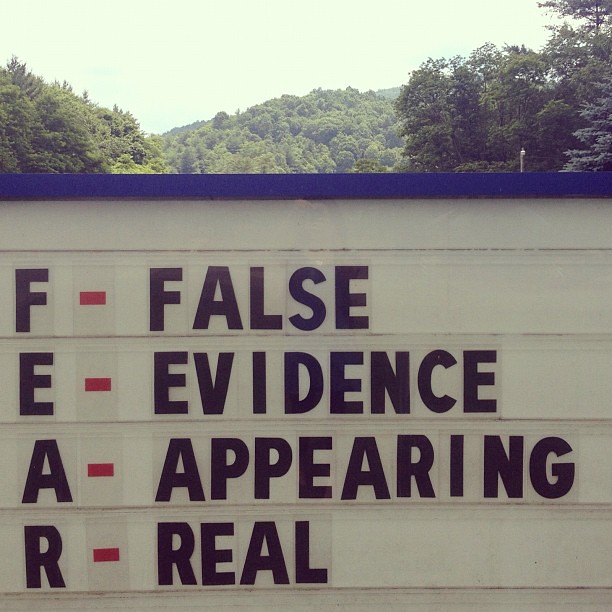
Some fun Alternative Acronym Definitions of F.E.A.R.
Courtesy of: https://artists-edge.com/some-fun-alternative-definitions-of-fear/
False Evidence Appearing Real – the canonical one
False Emotions Appearing Real
Future Events Appear Real
False Expectations About Reality
Finding Excuses And Reasons
For Everything A Reason
F*%# Everything And Run
Failure Expected And Received
Fighting Ego Against Reality
Frantic Effort to Appear Real
Federal Employee Anti-discrimination and Retaliation Act of 2002 (A positive take on it)
Feelings Expressed Allows Relief
Face Everything And Recover
Forgetting Everything’s All Right
 iPoem's Blog