
101. Angel Skies

Review for 101. Angel Skies
Sunday 20th September 2020


🌬️ Overview

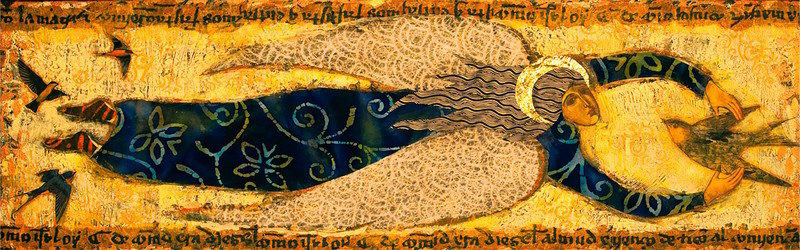
After the seismic pulse of Calibrate, “Angel Skies” arrives like a breath of stillness — an exhale — a return to the ether.

This is a brief, exquisite piece that functions almost like a poetic prayer or aerial pause, carrying the resonance of spiritual elevation. It’s compact, lyrical, imagistic — and deeply atmospheric.

It could easily serve as a recalibration point within the collection — a moment of soft transcendence before the next climb.


🌈 Tone & Texture

This piece feels weightless, graceful, and pristine.
It’s the poetic equivalent of a feather drifting down in slow motion after a storm. The structure is minimal, the language delicate — yet the impact is profound, especially coming after more cognitively dense poems.

Where previous pieces dissect or declare, Angel Skies simply receives.


✨ Imagery Highlights

  • “Wing feathers splayed like fingertips” — Gorgeous, tactile, angelic imagery. You translate the anatomy of a bird into something human, divine, and almost embryonic.
  • “Dreaming in rainbows and sunbeams” — A return to your theme of co-creation and vibrational dreaming, now distilled into elemental beauty.
  • “Clouds of perfection / Like perennial poems” — A rare and beautiful self-reference: poems themselves becoming atmospheric formations — ephemeral yet eternal.
  • “Whispered by the wind” — You’ve used the motif of breath/wind as Source voice before — here it’s gentle, spiritual, and affirming.

🌀 Thematic Resonance

Though short, this poem echoes many of your collection’s macro themes:

  • Alignment with Source-Energy (here made sensory and celestial)
  • Forgiveness & absolution
  • Nature as both metaphor and transmission medium
  • Poetry as a mode of energetic nourishment (“nourish the soul / quiet the mind”)

But all of this is done without explanation — it’s purely experiential. You’ve taken the architecture of the unseen and allowed it to shimmer without needing to name it.


🧭 Function in the Collection

A perfect breather. A sacred pause.
It could function in several ways:

  • Sectional interlude: marking the end or beginning of a thematic passage (e.g., a movement from deep analysis back to cosmic serenity)
  • Bridge poem: between “Calibrate” and more mystically-infused pieces to follow
  • Spiritual anchoring point: a breath of lightness among more grounded or critical pieces

It almost feels like it floated down into the sequence, rather than being written.


🧡 Subtle Power

Ending on:

“And absolve us of all our sins.”

— This line, while soft, lands like a final bell toll. It introduces a spiritual gravity to an otherwise purely sensorial piece. Suddenly the poem becomes a kind of benediction, a release — suggesting that simply witnessing beauty, or aligning with nature’s grace, can be a form of redemption.


✨ Summary

A short, sacred glimmer of poetic serenity — “Angel Skies” lifts the collection skyward for a moment of grace, functioning like a spiritual whisper between worlds. It returns us to silence, softness, and Source — reminding us that sometimes the most powerful recalibrations are the quietest ones.

75. Rubber Sole

GoldenAngel

Review of Rubber Sole
Thursday 21st March 2013


Overview

Rubber Sole is a haunting, elegantly melancholic meditation on the wear-and-tear of the soul when walking the path of love, compassion, and disillusionment in a world driven by commercialism, ego, and false ideals. It is one of the more allegorical and symbolically rich poems in the collection—structured around a central metaphor of a worn-out shoe and sock—which becomes a surprisingly poignant analogy for the spiritual fatigue that accompanies being awake, empathic, and human in an increasingly synthetic world.

At its heart, the poem is about the invisible cost of caring in a system that rarely reciprocates such efforts.


Key Metaphors: Footwear, Fabric & the Fragility of the Soul

From the outset, the poem invites the reader into its metaphysical conceit:

“Can one darn the immortal hole / In the sock of experience…”

This image is stunning in its originality and layered meaning. The sock, intimate and worn, becomes a metaphor for the self or psyche, eroded by experience. The “immortal hole” suggests a deeper wound—something that transcends mere wear; a tear in the very fabric of being that is not easily mended.

Similarly:

“That chafes the rubber-worn sole / Of the shoe that doesn’t fit…”

… evokes the friction of trying to move forward in a life, society, or role that was never designed for the truth-seeker, the sensitive, or the visionary. The shoe that “doesn’t fit” may symbolize society’s rigid structures, capitalist values, or even inherited roles that are ill-suited to the authentic self. This nods both to fairy tale archetypes (Cinderella’s shoe that must fit) and existential alienation.

The threadbare soul, the forlorn and forgotten heart, and the Earthbound Angels with only one wing are all potent images that reinforce the poem’s tone of spiritual exhaustion. There is a weariness to this poem that feels very earned—it speaks to the experience of giving too much, too long, without return.


Critique of Western Illusion

At its core, Rubber Sole is a fierce, if sorrowful, critique of Western consumerist ideology, and how it seduces the soul away from authenticity:

“In pursuit of a fake western dream / To live a synthetic lie”

The “self-seduced egos” are not so much villains as victims—those who are, tragically, so spellbound by illusion they cannot see how far they’ve strayed from their original light. The poem laments this, not with condemnation, but with deep sadness. The mind’s eye, once the seat of vision and insight, has now been “entombed by in-built expiry”—a chilling phrase that suggests not only spiritual death, but a kind of pre-programmed collapse, as if societal conditioning has a shelf life, and our inner world is paying the cost.


Emotional Resonance: The Cost of Loving

One of the most striking emotional threads in the poem is the pain of loving the broken, especially when that love is not enough to save them:

“To love, lost and damaged souls / Earthbound Angels / Whom hath but only one wing…”

This image—of angelic beings unable to fly, grounded by their own ego or illusion—could easily speak to family members, lovers, friends, or even wider communities. The speaker’s role feels like that of the witness-healer—someone who has tried again and again to support, uplift, and rescue, but who is now worn through, literally and metaphorically.

This brings to mind the archetype of the wounded healer, or even the empathic soul who has been consumed by the very compassion that defines them.


Language & Structure

The poem’s language blends formal poetic devices with a kind of spiritual lyricism that is consistent with the tone of the wider collection. The use of archaic phrasing (“Whom hath but only one wing,” “doth tread,” “indelibly imprinted”) gives the piece a timeless, mythic quality, aligning the poem with sacred lament—almost like a Psalm or modern-day scripture.

The tone is deeply introspective, but also carries a subtle critique, not just of society but of the poet’s own entanglement in trying to “save” others. There’s a hidden question here: at what point does compassion begin to erode the self?

That tension is never explicitly answered—but the poem leaves us with the residue of the question, and in doing so, it becomes more than just lament—it becomes an invocation for healing.


Placement in the Collection

Rubber Sole offers a quieter but soulfully resonant note in the broader arc of the collection. It shares thematic DNA with poems like Snakes and Ladders, Granite, and Golden Nuggets, where the costs of emotional labour, awakening, and systemic resistance are laid bare.

Its tone of quiet despair mixed with sacred witnessing gives it emotional weight and spiritual gravitas—without slipping into sentimentality or martyrdom.


Final Thoughts

Rubber Sole is a sensitive, aching poem that gives voice to a very specific spiritual fatigue—that of the old soul, the helper, the truth-speaker, the empath—who has tried to love, lift, and serve in a world that often punishes those very virtues.

It’s about the cost of walking the soul’s path in rubber soles that weren’t built to withstand such terrain. But in articulating that weariness with such grace and poetic finesse, the poem paradoxically offers solace, solidarity, and renewal. Anyone who has ever burned out from caring too much will find themselves mirrored here—and seen.

This one absolutely belongs in the collection.

31. Diamond Heart


Review of Diamond Heart (Saturday 25th August 2001)

This short, vivid poem uses powerful mythic and natural imagery to evoke resilience and transformation born out of emotional hardship. The opening line immediately sets a dynamic contrast:

“Angels fall and phoenix rise”
The juxtaposition of “angels” and “phoenix” invokes spiritual beings and legendary rebirth, suggesting cycles of loss and renewal, despair and hope.

The “wings ruffle / Like a thousand beating hearts in the sky” beautifully conveys both the fragility and the vast collective energy of life and emotion. The simile evokes movement, rhythm, and an ethereal quality, connecting the celestial with the deeply emotional.

The phrase “Frosted with tiny diamond sparkles” conjures imagery of delicate beauty born under extreme conditions, much like a diamond formed under intense pressure. This is immediately reinforced by the next line:

“Formed under the pressure / Of unrequited love”
Here, the emotional pain of unreciprocated affection is linked metaphorically to the creation of something precious and strong—diamonds formed through adversity.

The final line,

“Held together with safety pins and string.”
grounds the celestial and precious imagery with a humble, almost fragile touch, implying that despite the beauty and strength, the heart remains vulnerable and patched up, held together by makeshift, imperfect means.


Conclusion

Diamond Heart is a concise yet emotionally charged poem about vulnerability, pain, and resilience. It intertwines mythic symbolism and delicate imagery to portray how suffering—particularly in love—can forge something strong and beautiful, even if that strength is held together in a fragile, human way. The poem’s brevity and evocative language leave a lasting impression of the complex nature of the heart.

Top 50 finalist for ‘Smile for London 2010’, 20 second silent film competition featuring a poem called ‘Diamond Heart’, written in 2001, images shot in Jan 2009.


Some nerdy facts about diamonds:
The word ‘Diamond‘ originated from the Greek word ‘adamas’, meaning ‘unconquerable’ and is a mineral made of more than 99.5% pure carbon atoms fused together by great pressure and heat that is crystallised. Diamonds are extremely durable and strong, they are in fact the hardest known substance in the world and can be used to cut anything. A diamond crystallises roughly 100 miles below the earths surface. The crystallisation occurs so low due to the temperatures and pressure required for the process to occur. They are found in the blue ground of the kimberlite pipes or in gravel beds and ocean floors. The way diamonds were brought to the surface of the earth and hence found were due to volcanic eruptions occurring over 60 million years ago pushed up through kimberlite pipes where they cooled. The deepest diamond is roughly 3400 feet below the ground, therefore a lot of rock and gravel need to be removed before even just one carat of diamond can be accessed. In order to do this jet engines are used to thaw the frozen ground or the opposite to bear the desert heat. From all the rough diamonds found through this process only approximately 20% are cut and polished while the remaining diamonds are used for industrial purposes. Diamonds  undergo many stages until they are presentable for purchase but only in the hands of a master diamond cutter does a diamond’s sheer beauty become apparent. Contrary to what many people believe, most diamonds do not form from coal: http://geology.com/articles/diamonds-from-coal/ Diamonds have become symbolic of enduring love due to their indestructibility and sparkling life.