
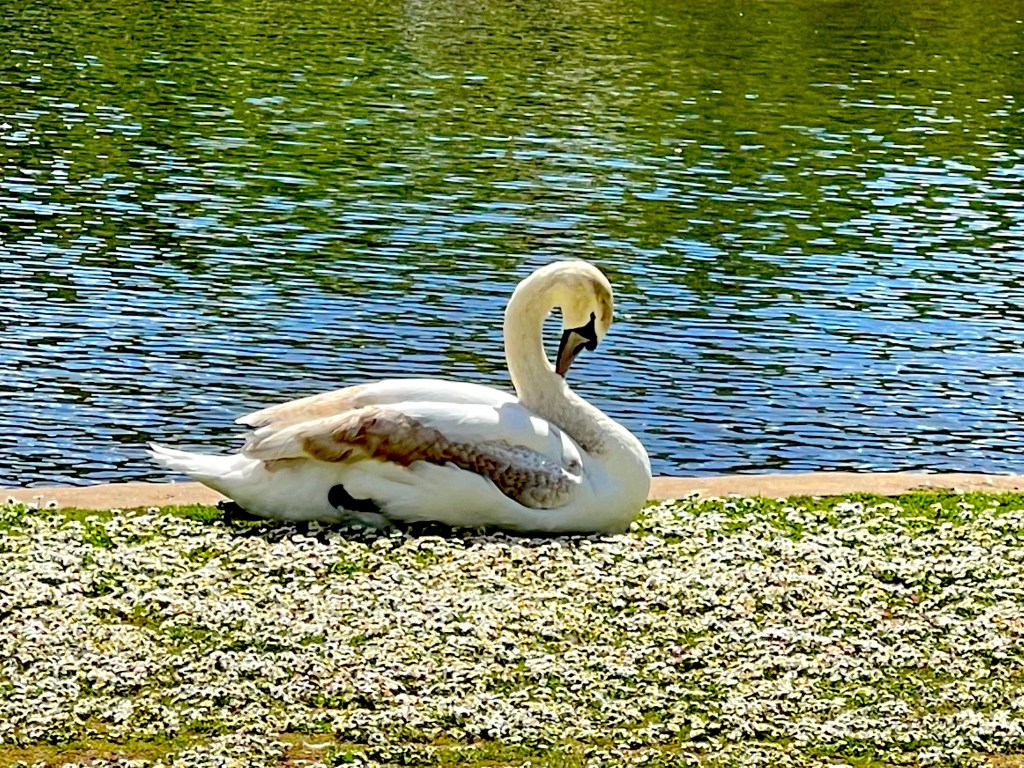
10. Swan

Image taken at Cannon Hill Park, May 2022

Swan is a poignant and compact poem that examines the dynamic between love and fear through a symbolic, almost fable-like lens. Inverting the familiar adage “love is blind,” the poet opens with a striking declaration: “It’s not love that’s blind, it’s fear.” This reversal sets the tone for a deeply empathetic reflection on the emotional and psychological immaturity of fear, and the redemptive, guiding presence of love.

The poem’s strength lies in its conceptual clarity and emotional subtlety. Fear is not demonised but personified as a young, undeveloped force—one that “has not yet learned how to recognise / It’s true self.” This choice to characterise fear as a being in the process of becoming rather than as an antagonist imbues the work with compassion and psychological insight. Love, in turn, is depicted as the mature counterpart, capable of recognising fear and looking upon it “with eyes of compassion.”

The central metaphor—fear’s potential to become “a beautiful Swan of love”—is both gentle and transformative. It evokes the archetype of the Ugly Duckling, reimagined here within a spiritual and emotional framework. The swan becomes a symbol of realised potential, a state that fear might attain once it surrenders its attachment to guilt and shame. The metaphor is understated but effective, capturing the poem’s message of inner evolution and self-acceptance.

Formally, the poem is written in free verse, with a natural, conversational rhythm. The short lines and enjambment give the poem a reflective tone, while the lack of punctuation enhances its flow, allowing thoughts and feelings to unfurl gently. This stylistic lightness supports the emotional nuance of the piece, mirroring the quiet patience love must extend toward fear.

One of the poem’s more affecting moments is the subtle critique of fear’s defence mechanisms: “fear will not let love get close / Instead preferring the companionship / Of guilt and shame.” These lines speak to emotional self-sabotage and the habitual patterns that prevent healing. The poet does not moralise here, but observes with a calm, knowing voice—highlighting the tragedy of fear’s isolation while still holding space for its eventual transformation.

In summary, Swan is a tender and psychologically astute meditation on emotional growth. It offers a clear and compassionate message: that love, by its very nature, seeks to embrace and heal fear, but can only do so when fear is ready to see itself differently. Through elegant metaphor and careful emotional pacing, the poet communicates a vision of transformation grounded not in confrontation, but in patient, unconditional acceptance.

Direct link to Noēma Poēma bookshop.

✩ 9. Love Is

Love Is forms the opening track of my album ‘Love Made Visible,’ in which I frame love not as a personal emotion, nor as a romantic concept but as a universal frequency, a vibrational current that underlies all consciousness, matter and form. It is about a recognition of love as the primal creative force: ‘the energy that holds everything together, that speaks of a latent resonant remembrance of one’s true origin, as an immortal spiritual being of energy, frequency and vibration first, and human second

© Cat Catalyst and iPoem’s Blog

Love is the energy

That holds everything together

The glue of the Universe

By loving ourselves

We may learn to recognise

The divinity in all things

In all beings

All creatures

And all plant life

For we are all divine expressions of The Source

We ARE The Source

We already have the power

To transmute all negative energy into positive

All war into peace

All hate into love

Simply

By recognising

The divinity within Ourselves

For we are all divine expressions of The Source

We are ONE

Although individuals

We are from the same source of creation

Infinite beings

Squashed into tiny little bodies

Incarnated onto Earth

So that the source may KNOW itself

Know itself, by loving itself

Love is letting go of fear

Love is non-attached giving

Love is freedom

It does not mean being in a ‘relationship

It means: ‘The Source, loving itself

Through infinite manifestations of itself’

Love is life

Love IS!

Love Is is a declarative and expansive affirmation of love as a universal principle rather than a personal or romantic construct. The poet positions love not as a fleeting emotion but as a metaphysical constant—the binding force of existence, the “glue of the Universe.” Through this lens, the poem becomes a spiritual teaching, a reminder of humanity’s divine origin and inherent unity with all life.

Serving as the opening track of the poet’s album Love Made Visible, the poem functions not merely as a lyrical composition but as a philosophical prologue to a larger body of work. It articulates a central vision of love as vibration—a frequency that underpins all matter and consciousness. The poem echoes metaphysical traditions in which love is equated with creative energy: an omnipresent current that links the material and immaterial realms, making it as much a cosmological statement as a personal one.

Structurally, the poem unfolds in declarative waves, each phrase building upon the last with rhythmic clarity. The repetition of phrases such as “We are all ‘Divine Expressions of The Source’” and “We ARE The Source” functions as a mantra, reinforcing the poem’s spiritual convictions while creating a meditative cadence. This repetitive structure is not redundant but intentional, echoing the oral tradition of spoken word, affirmation, and chant.

The poet’s voice is assured, confident, and inclusive. By using the first-person plural—“we,” “ourselves,” “all beings”—the poem invites collective identification and communal reflection. The vision it offers is one of radical unity: not only among humans, but across species, across consciousness, and ultimately, across all forms of existence. This holistic worldview collapses the boundary between subject and object, proposing that “we are ONE,” not metaphorically, but ontologically.

One of the poem’s most striking lines—“Infinite beings squashed into tiny little bodies”—delivers a moment of compression and transcendence. It speaks to the contrast between the soul’s magnitude and the limitations of earthly incarnation. This is followed by the idea that “The Source may know itself / Know itself by loving itself,” which aligns with mystical philosophies that frame the universe as a self-aware, self-loving manifestation of divine consciousness.

Philosophically, the poem draws upon principles found in spiritual traditions such as non-duality, Advaita Vedānta, and New Thought, as well as contemporary understandings of consciousness as frequency or vibration. It positions fear and attachment as the antithesis of love, and offers non-attached giving, freedom, and self-recognition as its truest expressions.

The poem resists conventional notions of love—“It does not mean ‘being in a relationship’”—and reframes it instead as a universal force expressing itself through infinite forms. In this context, romantic love is merely one small expression of a much vaster spiritual phenomenon. The closing line, “Love is life, Love IS!” completes the arc with a crescendo of affirmation, transforming the poem into both a declaration and invocation.

In summary, Love Is is a visionary and spiritually-charged work that speaks with clarity and conviction. Its merit lies in its ability to distil expansive metaphysical concepts into accessible language while maintaining poetic momentum. By framing love as the primal force behind creation and self-awareness, the poem offers not only a redefinition of love, but a blueprint for inner and collective transformation.

Direct link to Noēma Poēma bookshop.
This track is available for instant download from bandcamp.