
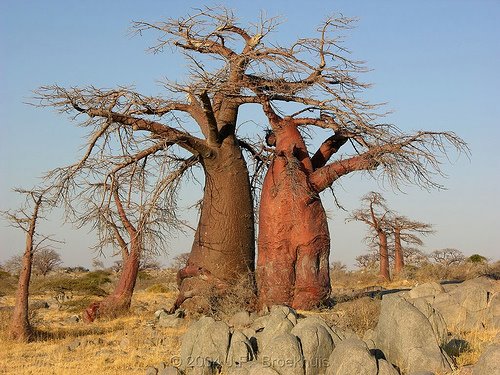
Baobab Tree is a quiet yet emotionally charged reflection on humanity’s estrangement from nature, and the poet’s personal search for connection, reverence, and simplicity in a world increasingly defined by consumption and disconnection. Framed through an intimate interaction with a tree, the poem operates as both a love letter to the natural world and a lament for what has been lost through modern life.
The Baobab itself serves as a central figure—grounded, ancient, humble. It is not simply a tree, but a companion: “My friends / Are the Baobab trees in the park.” This anthropomorphising does not feel whimsical or sentimentalised; rather, it is a sincere extension of the poet’s longing for honesty and reciprocity, qualities found lacking in human society but deeply present in nature.
The tactile description of the tree—“Its bark was hot / Soaking in the sunshine”—grounds the poem in sensory immediacy. The poet’s awe at the tree’s form, its “bulging out of the Earth,” echoes a kind of sacred regard for the quiet miracle of the living world. This reverence is extended to the Earth itself: “This magic earth, soil, land,” the poet calls it, recognising it not just as matter but as a nurturing, intelligent force that sustains life.
There is a subtle undercurrent of sadness and isolation running through the piece, particularly in the line, “Some might say it is beautiful / Romantic and poetic / Except it is my sad truth.” This confession hints at the alienation the poet feels—finding more resonance with a tree and a breeze than with people. This loneliness, however, is not despairing but contemplative, forming the basis for deeper gratitude and awareness.
Midway through, the poem shifts into a tone of praise: an almost devotional awe at how “seeds can grow out of the earth” and provide food, fragrance, oxygen—“an incredible source of nourishment.” This listing serves as a kind of natural litany, a moment of wonder and thanksgiving that contrasts with the more sombre reflection that follows.
The latter section turns toward the ecological and ethical dimensions of human life: “Each human being’s existence / Depletes the planet… / Creates waste.” These lines do not condemn, but rather invite self-examination. The poet includes themselves in the reflection—“I am probably no better than anyone else”—and thereby avoids moralising. The effect is one of shared responsibility rather than accusation.
Importantly, the poem does not end in despair but in a call for awareness and stillness: “Let go of your fears / Find stillness and calm / Amidst the chaos of un-civilisation.” This final phrase, “un-civilisation,” is a sharp and effective critique, suggesting that modernity, though technologically advanced, lacks the soulfulness and respect that true civilisation demands.
Stylistically, the poem maintains a natural rhythm, with short lines and intuitive enjambment that mirror the reflective, almost meditative mood. The language is accessible yet thoughtful, allowing the emotional and philosophical layers to emerge gradually.
In summary, Baobab Tree is a gentle but powerful meditation on the sacredness of nature and the ethical challenge of being human in an age of environmental crisis. Its strength lies in its honesty, its tactile engagement with the natural world, and its refusal to separate the personal from the planetary. The poem invites readers not only to appreciate the beauty of a tree, but to consider their place in the larger web of life—and how they might begin to honour it more fully.
___
Baobab Tree was written in Anzac Square, Brisbane, May 1998
 iPoem's Blog