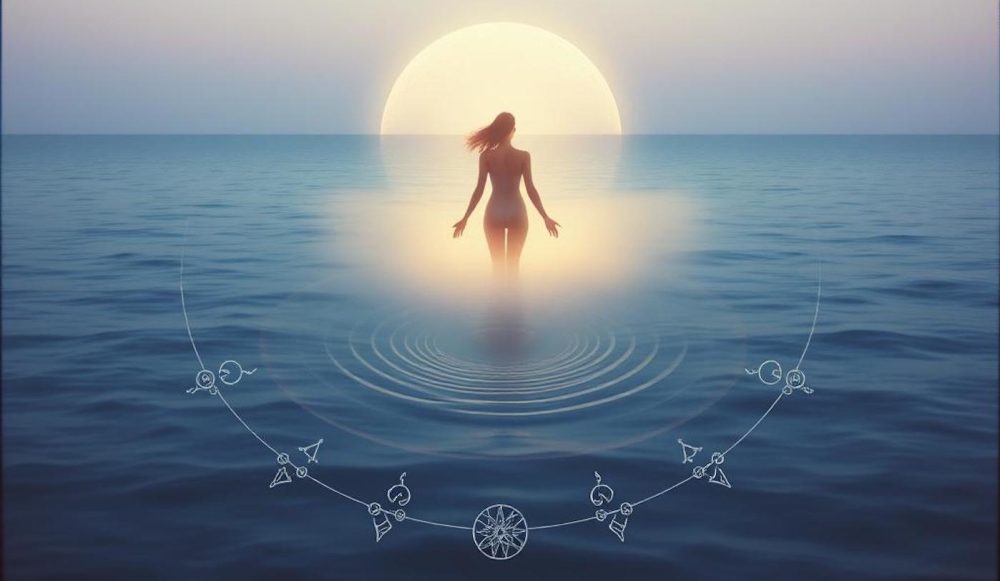

Now is the future
And all our future now’s
Ever again to be
By being fully present
In the magnificence of this moment
Presenting ourselves in the here and now
Where Love’s magical omnipotence resides
Time reaps the harvest of our karmic destinies
Sewn from the seeds of integrity and truth
Planted in the pastures of this present moment
Of continuous now, is the new now
The future is in the ‘Now’
And all our future now’s
Ever again to be. ✩
In The Future Is Now, the poet returns to one of their central philosophical preoccupations: the nature of time and the transformative power of presence. This short but resonant piece functions as a contemplative meditation on the eternal “now,” blending metaphysical insight with poetic rhythm to distill a complex spiritual truth into accessible, mantra-like language.
The opening line, “Now is the future,” subverts linear conceptions of time, setting the stage for a poem that collapses past, present, and future into a single point of awareness. This inversion immediately challenges the reader to reorient their thinking, suggesting that the “future” is not an event to be awaited but a condition that is actively shaped in the present moment. The poet’s circular phrasing—“and all our future nows / Ever again to be”—reinforces the idea of continuity rather than chronology. It is an affirmation of the infinite unfolding of time within the present.
At the heart of the poem lies the imperative to be “fully present / In the magnificence of this moment.” The language here is devotional, even celebratory. The word “magnificence” elevates the present from mundane experience to sacred encounter. This is not mindfulness as a technique, but as a form of spiritual embodiment—“Presenting ourselves in the here and now” implies both vulnerability and intention: showing up, consciously and completely, to life.
The middle of the poem deepens the philosophical dimension, introducing the concept of karmic causality: “Time reaps the harvest of our karmic destinies / Sewn from the seeds of integrity and truth.” This agrarian metaphor situates ethical action in a spiritual ecosystem, where the quality of one’s present choices directly influences the texture of one’s future. The use of “sewn” (rather than “sown”) may be a typographical anomaly, but even if unintentional, it lends an interesting layer—suggesting that the threads of destiny are stitched together as much as planted. Whether deliberate or not, it works in reinforcing the interconnectedness of action, time, and outcome.
The repeated motif of “the present moment” as a fertile ground—“pastures of this present”—recalls earlier poems where Earth and growth serve as metaphors for spiritual development. Here, the present is both a field and a fulcrum: the place where time bends, and potential crystallises into reality.
Stylistically, the poem is cyclical and rhythmic, echoing its own thematic focus. The repetition of key phrases—“future nows,” “this moment,” “now”—functions almost like a chant, guiding the reader into the very state the poem describes. The lack of traditional punctuation allows for a fluid, unbroken flow of thought, reinforcing the idea of temporal continuity.
While succinct, the poem carries a meditative weight. It offers not a narrative or argument, but a distilled truth—an experiential insight into the nature of time and consciousness. The phrase “moment of continuous now, is the new now” acts as both a philosophical statement and a poetic gesture toward eternity.
In conclusion, The Future Is Now is a concise yet profound articulation of presence as both a spiritual practice and a creative act. It gently dismantles the illusion of linear time, encouraging the reader to awaken to the power of the present as the only true site of agency, transformation, and becoming. As with much of the poet’s work, the message is simple, but the implications are far-reaching: the future is not something that happens to us, but something we shape—moment by moment—through the consciousness we bring to now.
 iPoem's Blog